 By Savedollars Team
 The Anatomy of an Applicant Tracking System
Modern hiring is a game of mathematics, not aesthetics. When you submit a PDF to a corporate portal, it is immediately stripped of its formatting and passed through a Natural Language Processing (NLP) algorithm. If your resume does not score above a specific threshold (often 75-80%), it is auto-rejected.
TF-IDF (Term Frequency-Inverse Document Frequency)
The core algorithm powering many legacy and modern ATS platforms is based on TF-IDF. This statistical measure evaluates how relevant a word is to a document within a collection.
In the context of an ATS:
- Term Frequency (TF): How many times does the skill “React.js” appear in your resume?
- Inverse Document Frequency (IDF): How rare is the term “React.js” in the broader dataset of all applicants? If everyone has it, its weight decreases. If it’s a specific requirement from the job description that few applicants possess, its weight skyrockets.
Reverse-Engineering the Bot
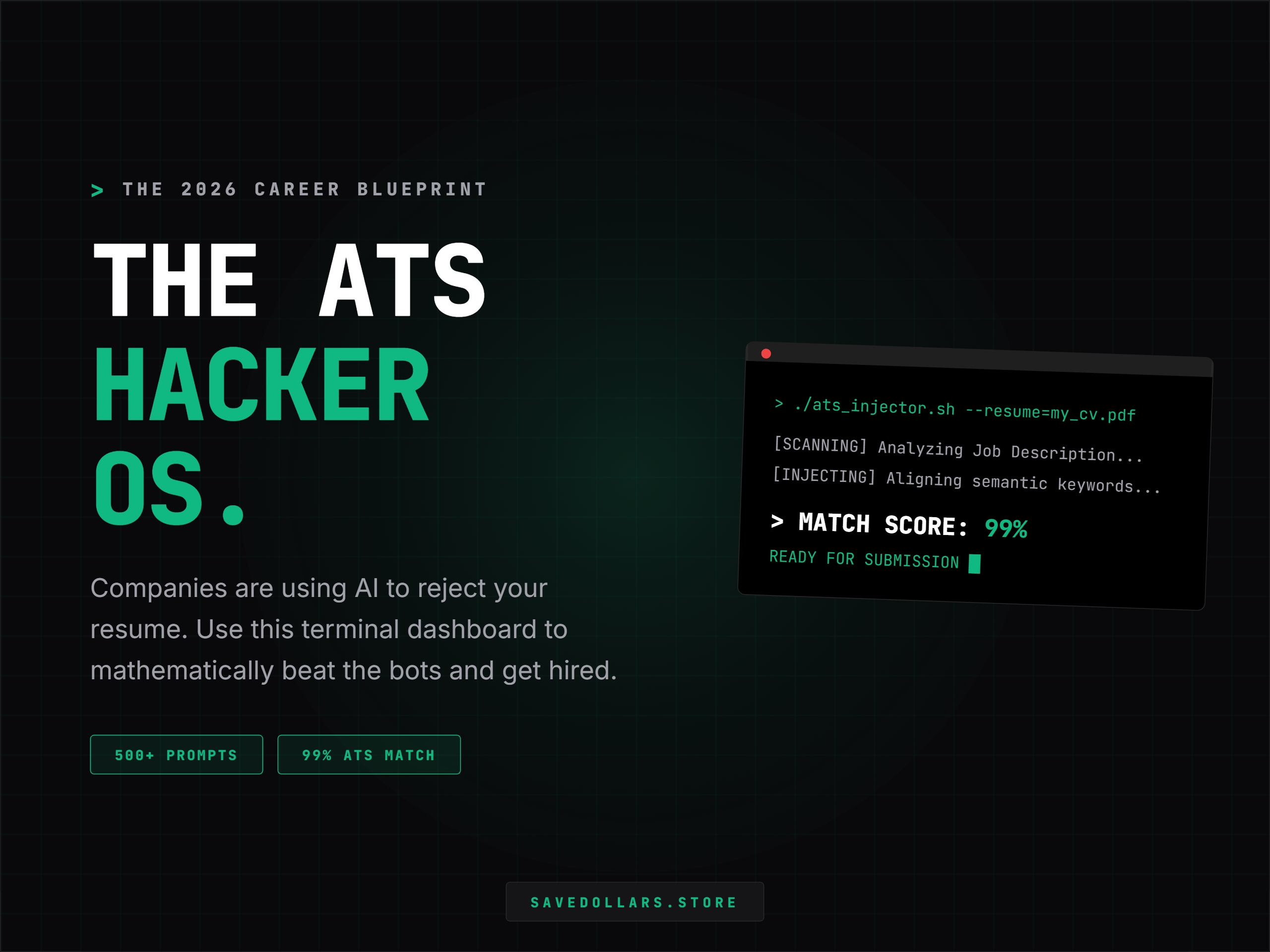
To build the ATS Hacker OS, we had to reverse-engineer this algorithmic logic locally in the browser.
Our engine operates in three distinct phases:
- Stop-Word Filtration: The text from the job description and the resume is normalized. Common words (and, the, is, but) are stripped out entirely.
- N-Gram Tokenization: The engine doesn’t just look for single words (unigrams), it looks for contextual pairs (bigrams and trigrams) like “Project Management” or “Agile Software Development”.
- Cosine Similarity Scoring: The engine maps your resume’s keyword vectors against the job description’s keyword vectors and calculates the cosine of the angle between them. A score of 1 means perfect alignment; a score of 0 means zero relevance.
Impact Quantifiers and Action Verbs
Beyond raw keyword matching, advanced ATS parsers look for syntactical structures indicating impact. They search for action verbs (e.g., “Architected”, “Spearheaded”) immediately followed by numeric quantifiers (e.g., “30% increase”, “.2M revenue”). The ATS Hacker algorithm explicitly audits your bullet points to ensure this mathematical structure is present.
Conclusion
Understanding the math behind ATS parsing allows you to stop treating job applications like a lottery. By utilizing local-first algorithmic auditing tools, you can mathematically guarantee that your resume passes the initial automated filters.
⚡ Verified Architecture
⭐⭐⭐⭐⭐ 100% Offline & Private
ATS Hacker OS | AI Resume Screeners & Interview Simulator
Reverse-engineer applicant tracking bots with TF-IDF keyword density analyzers, missing term audits, and clean vector PDF generation.
ATS Hacker OS | AI Resume Screeners & Interview Simulator
Reverse-engineer applicant tracking bots with TF-IDF keyword density analyzers, missing term audits, and clean vector PDF generation.