 By Savedollars Team
As the international arms control architecture faces unprecedented dissolution following the expiration of bilateral treaties and the acceleration of multi-polar deterrence, a far more silent, subterranean revolution has taken root: the aggressive integration of Artificial Intelligence across Nuclear Command, Control, and Communications (NC3). While pop-culture doomsday tropes fixate on fully autonomous robotic launch triggers—the fictional “Skynet” paradigm—military technologists and strategic defense researchers know that the true existential threat of 2026 is far subtler: algorithmic decision compression, automated sensor distillation, and the cognitive collapse of the ‘Human-in-the-Loop’ doctrine.
Core Doctrine: Cold War Warning (25–30 min Launch-Under-Attack Window) ➔ Hypersonic Ingestion (<10 min) ➔ Autonomous Sensor Filtering ➔ Algorithmic Invariant Pruning ➔ Flash Escalation Hazard
1. The Geometry of Crisis: How Sensor Fusion Compresses Nuclear Launch Windows
Throughout the Cold War and into the early 2000s, nuclear deterrence rested upon an operational cushion known as strategic warning latency. Early-warning radar arrays and ballistic missile early warning satellites (such as SBIRS) fed raw infrared and doppler telemetry into human-curated analysis cells at NORAD and equivalent command posts. Analysts had between 20 and 30 minutes to cross-validate satellite signatures against ground-based phased-array radar data before briefing head-of-state authorities.
In 2026, two technological forces have pulverized this temporal cushion into non-existence:
- Hypersonic Glide Vehicles (HGVs) & Depressed-Trajectory Cruise Missiles: Flying at Mach 5+ through atmospheric skip trajectories, modern hypersonic weapons compress potential sensor detection-to-impact windows down to 5 to 8 minutes.
- Multi-Domain Sensor Saturation: Sensor platforms now ingest millions of concurrent telemetry streams—including commercial synthetic aperture radar (SAR), high-frequency electronic signals intelligence (SIGINT), undersea acoustic sonar arrays, and autonomous drone swarm telemetry.
Because no human staff can manually correlate billions of multi-sensor data points within 300 seconds, militaries have deployed predictive AI sensor-fusion pipelines. These algorithmic models perform high-speed anomaly classification, trajectory extrapolation, and target allocation. In doing so, the algorithm decides what reaches the commander’s tactical heads-up display (HUD) and what gets discarded as background noise.
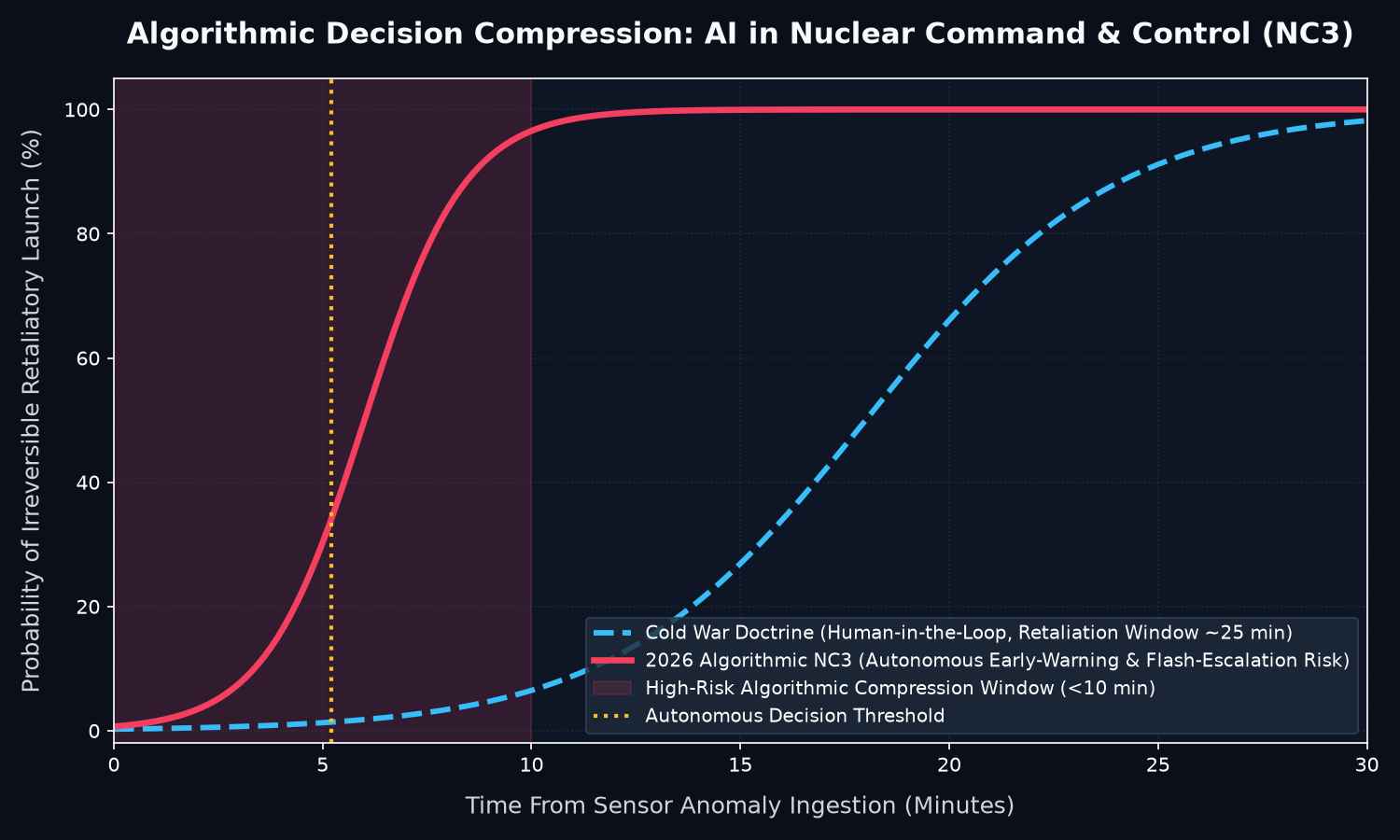
Figure 1: The Algorithmic Decision Compression Curve. Algorithmic early-warning triage forces critical escalation thresholds into a dangerous sub-10-minute window, drastically reducing verification redundancy.
2. The Fatal Fallacy of the ‘Human-in-the-Loop’ Doctrine
Official defense white papers universally reiterate the doctrine that “a human will always remain in the loop for decisions regarding the employment of nuclear weapons.” However, cognitive engineering and systems safety research demonstrate that when decision-making timelines collapse below the cognitive processing threshold of human deliberation, “Human-in-the-Loop” becomes a legalistic fiction.
This dynamic manifests through three catastrophic failure modes:
- Automation Bias & Epistemic Deference: When an AI system presents an alert marked “98.7% Confidence: Intercontinental Ballistic Missile Launch Detected — Window to Retaliation: 190 Seconds”, no human commander possesses the forensic capability to unpack the neural network’s weights or audit the raw telemetry before the launch window closes. The human operator is reduced to an affirmative rubber stamp.
- Algorithmic Pre-Selection Bias: An AI does not need launch authorization to cause a nuclear strike. If the AI’s internal heuristics discard conflicting satellite telemetry as “atmospheric refraction” while escalating a false positive as an imminent silo strike, the information architecture itself dictates the outcome.
- Adversarial Data Poisoning & Hallucinatory Triggers: Machine learning models are inherently vulnerable to out-of-distribution artifacts and adversarial spoofing. Just as Stanislav Petrov in 1983 correctly identified a Soviet satellite glitch that mistook high-altitude sun reflections on cloud tops for US Minuteman launches, a rigid machine learning classifier trained on synthetic crisis simulations could flag anomalous space weather or coordinated cyber-spoofing as an existential first strike.
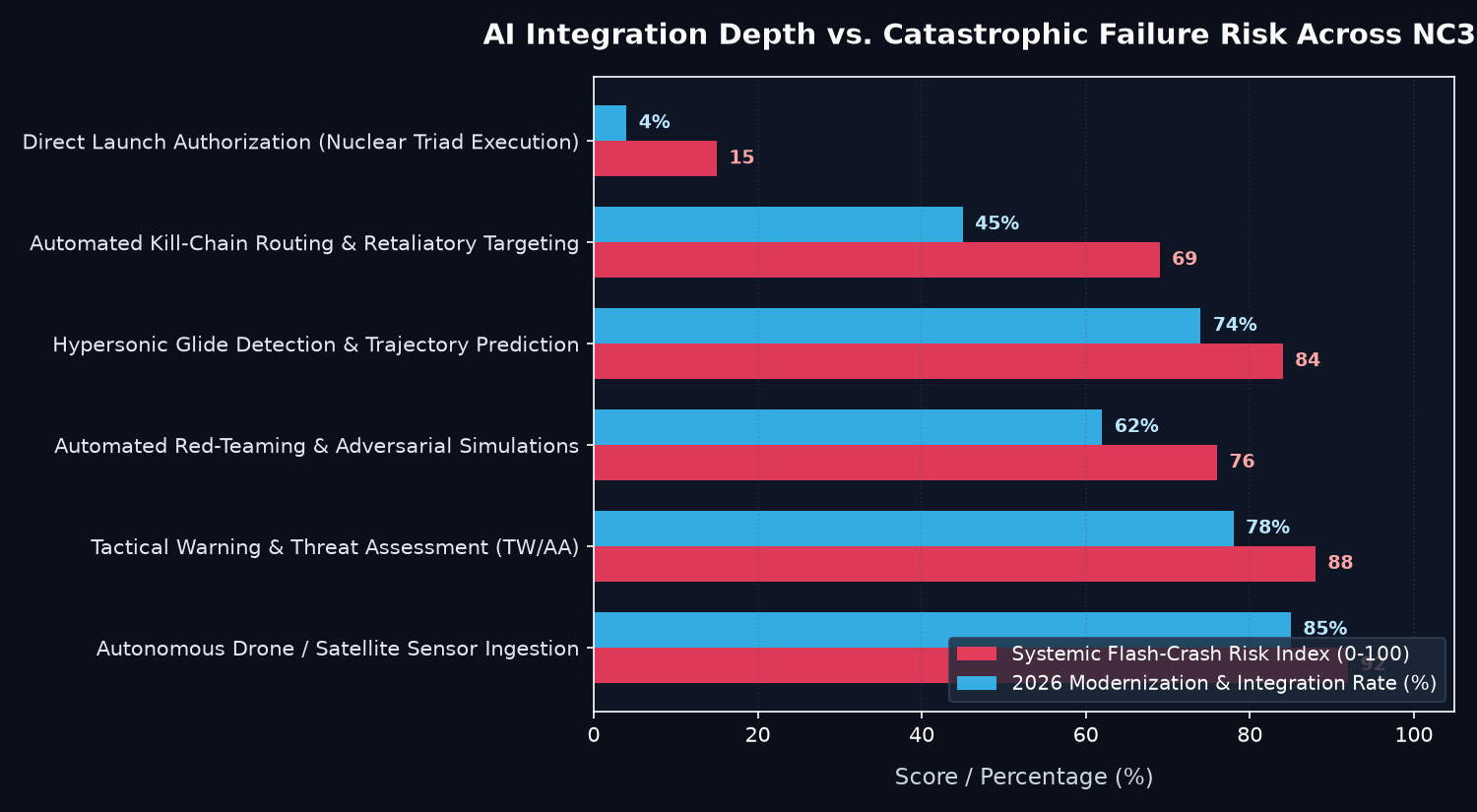
Figure 2: NC3 Subsystem Risk Taxonomy. While direct triad launch authorization remains heavily air-gapped, high modernization rates in autonomous sensor fusion and tactical warning create acute systemic vulnerability.
3. Flash-Escalation: Financial Flash-Crashes Applied to Nuclear Deterrence
In financial markets, the advent of high-frequency algorithmic trading introduced the phenomenon of the “Flash Crash”—where autonomous algorithms responding to microsecond fluctuations in pricing models fed into each other’s feedback loops, wiping out trillions of dollars of equity in minutes before human intervention could halt trading.
Strategic analysts at leading think tanks have identified an identical mathematical dynamic in Multi-Agent Algorithmic Deterrence. If Nation A deploys an AI agent to detect preemptive mobilization by analyzing social chatter, logistics pipelines, and satellite imagery, Nation B’s defensive AI will immediately detect Nation A’s automated alert posturing. Nation B’s algorithm then automatically shifts its strategic bomber fleet to airborne alert and disperses mobile ICBM launchers. Nation A’s AI interprets this dispersal as confirmation of an offensive preparation, automatically advancing its alert level to DEFCON 2.
This is Algorithmic Flash-Escalation: a runaway closed-loop cascade where two autonomous systems, each programmed with defensive optimization heuristics, drive bilateral tension to the brink of nuclear release without a single human having ordered an escalation.

⚡ Frontier Autonomous Systems Architecture
⭐⭐⭐⭐⭐ Turnkey Docker & MCP Codebase
Claude 5.5 & The Agentic Workforce | Production Engineering Playbook
Master how enterprise engineers design robust multi-agent state machines, deterministic guardrails, and isolated sandbox execution environments. Learn the exact architectural patterns required to prevent autonomous agent loops, context bleed, and systemic cascading failures in mission-critical AI systems.
4. Mathematical Rigor: Where Autonomous Systems Break Down
The core issue in autonomous strategic defense systems mirrors the challenges seen in modern software engineering: loss of determinism and non-linear failure propagation. In formal software verification, safety-critical systems (such as flight control software or medical pacemakers) are bounded by deterministic state machines where all state transitions are provably invariant.
However, modern generative and deep neural architectures operate as probabilistic approximations:
When input sensor tensors are subjected to cyber-spoofing, electromagnetic pulse interference, or unmodeled atmospheric anomalies, the latent representation enters out-of-distribution space. Because deep neural networks are uncalibrated outside their training manifolds, they output extreme confidence scores on completely erroneous data. In a civilian LLM agent, this results in a hallucinated code function; in an NC3 early-warning pipeline, it threatens civilization-ending miscalculation.
5. Strategic Solutions: Building Verifiable Firewalls & Air-Gapped Deliberation
To prevent algorithmic flash-escalation from triggering catastrophic consequences, arms control experts and senior defense architects advocate for immediate multilateral technical treaties:
- Mandatory Latency Firewalls: Introducing intentional, non-negotiable physical cooling-off periods that prevent automated systems from transmitting alert-state escalation without verified multi-channel human consensus.
- Formal Proof Verification for Military Code: Banning probabilistic black-box neural networks from core telemetry classification pipelines, replacing them with formally verified, deterministic logic filters.
- Bilateral AI De-Escalation Protocols: Establishing direct, air-gapped algorithmic hotlines between strategic rivals that can verify simulated anomalies and prevent automated tit-for-tat escalation cascades.
• Explore our deep-dive analysis on Why Autonomous Agents Break Production: Context Bleed & Loop Traps.
• Review our technical benchmark on Context Engineering vs. RAG: Architecture & Mathematical Invariants.
• Understand state-machine control in ReAct Agent vs. Agentic AI: Why Thought-Action Loops Fail at Scale.