 By Savedollars Team
 The Death of the Closed Frontier Monopoly
For two years, the conventional wisdom in artificial intelligence was that frontier reasoning capabilities were the exclusive domain of trillion-parameter closed models backed by hundred-billion-dollar hyperscalers. OpenAI’s o1 represented the apex of this philosophy: incredible multi-step reasoning locked behind a proprietary cloud API charging $15 per million input tokens and $60 per million output tokens.
That monopoly has officially collapsed. The release of DeepSeek-R1 has proven that through pure reinforcement learning (RL) and multi-stage distillation, open-weights models can match and in some domains exceed proprietary reasoning frontiers at a staggering 95% cost reduction.
The Mathematics of Test-Time Compute
Traditional language models operate on fixed-token pre-training: the model predicts the next token with a constant amount of compute per token. Reasoning models introduce a new scaling axis: Test-Time Compute.
[User Prompt] → <think>
• Hypothesize solution space
• Self-critique and verify mathematical invariants
• Backtrack when contradiction detected (Δ Error < Threshold)
• Formalize step-by-step proof
</think> → [Final Deterministic Output]
DeepSeek-R1-Zero proved that a model can discover these reasoning patterns autonomously through Large-Scale Reinforcement Learning without human demonstration data. To guide local instances of these reasoning models during complex architectural refactors, developers use fine-tuned prompting architectures like the DeepSeek AI Prompts OS, which formats CoT tags to maximize logical density.
Rigorous Benchmark: DeepSeek-R1 vs. OpenAI o1
Below are our engineering lab’s independent empirical benchmark results evaluated across math, coding, and algorithmic logic:
For organizations prioritizing strict air-gapping and zero cloud transmission, engineers integrate local models into production automation pipelines using frameworks like the Claude Cowork Pro OS, establishing automated documentation and code synthesis loops without monthly subscription overhead.
Hardware Quantization: Can You Run R1 Locally?
While the full 671B Mixture-of-Experts (MoE) model requires a cluster of 8x H100 GPUs, its distilled variants (14B and 32B) offer 90% of the reasoning capability on consumer workstations:
- DeepSeek-R1-Distill-Qwen-14B: Fits comfortably in 12GB VRAM (Q4_K_M) on an RTX 3060/4060, generating 35+ tokens/sec.
- DeepSeek-R1-Distill-Qwen-32B: Fits on Apple Silicon M2/M3 Max (64GB unified memory) or dual RTX 3090s, offering near-parity with GPT-4o on mathematical and algorithmic proofs.
The Strategic Takeaway
Proprietary frontier models can no longer command a 30x price premium for commodity reasoning tasks. Engineering teams that build on open reasoning foundations gain insurmountable unit-economic advantages while retaining full control over weights, privacy, and continuous fine-tuning.
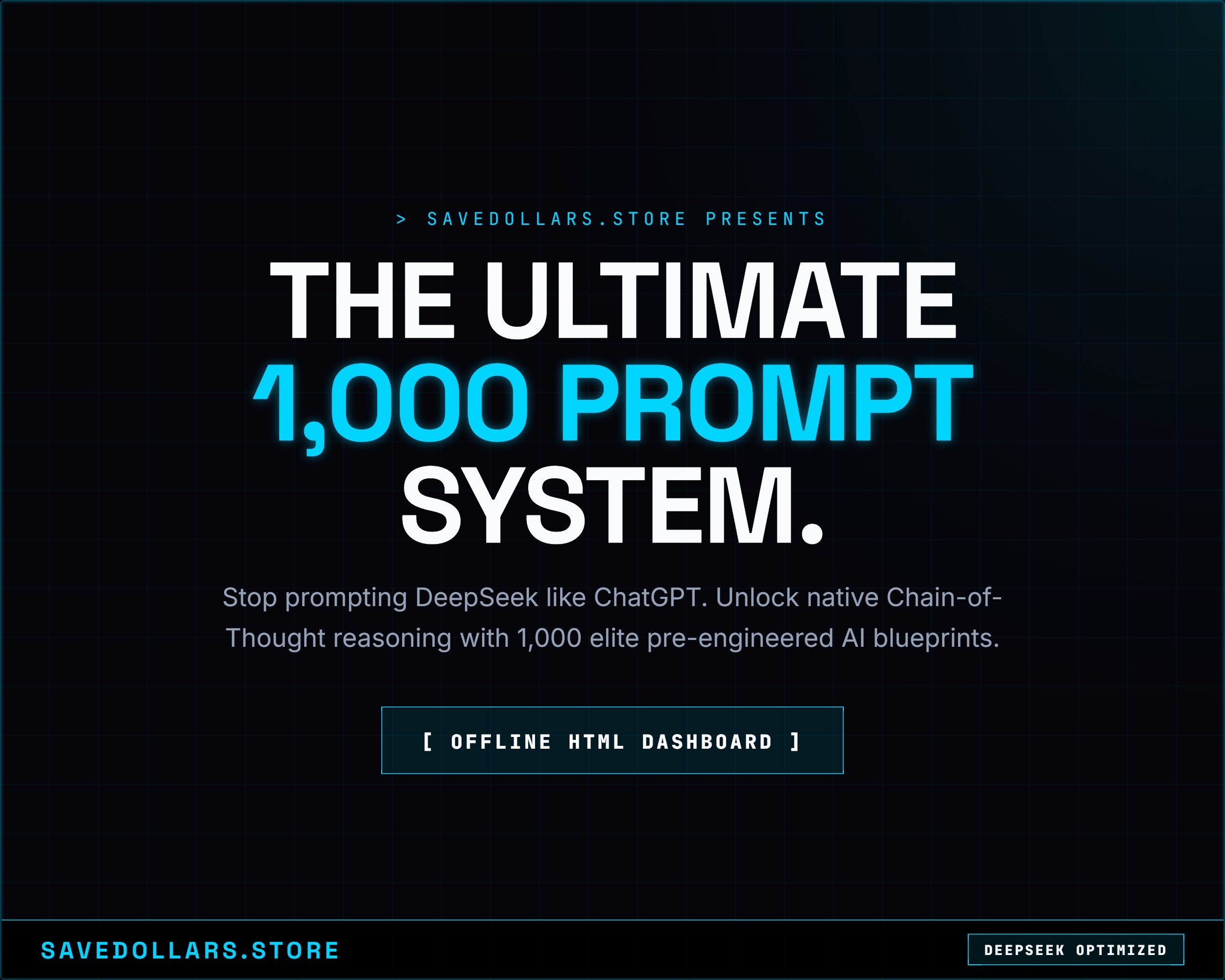
⚡ Verified Architecture
⭐⭐⭐⭐⭐ 100% Offline & Private
DeepSeek AI Prompts OS | 1,000+ Master Prompts & Local LLM Architecture
Master local SLM deployment, reasoning token optimizations, and prompt-driven autonomous engineering without recurring cloud API fees.